
Cebu - Cebu City
Cebu City, known as the "Queen City of the South", is the oldest city in the Philippines and one of the country's most important economic and cultural centers. It combines centuries of Spanish colonial history with modern shopping malls, vibrant nightlife, and easy access to beaches and nearby islands.
The city serves as the main gateway to Central Visayas and is an excellent starting point for exploring southern and northern Cebu, as well as nearby islands such as Bohol.
Mactan Island is a tropical island located just east of Cebu City and is connected to the mainland by two bridges: the Marcelo Fernan Bridge and the Cebu–Cordova Link Expressway (CCLEX). It is home to the bustling city of Lapu-Lapu and the Mactan–Cebu International Airport (CEB), making it the main gateway to Central Visayas.
Cebu City offers one of the Philippines' best nightlife scenes outside Metro Manila. Whether you prefer rooftop cocktails with skyline views, lively clubs, live music, or relaxed pubs, there's something for every taste. Most nightlife is concentrated in IT Park, Lahug, Mango Avenue (General Maxilom Avenue), and Escario Street.
Mactan Island known for its luxury beach resorts, crystal-clear waters, and excellent diving, Mactan Island offers a convenient beach escape just minutes from the city. It is also historically significant as the site of the Battle of Mactan in 1521, where local chieftain Lapu-Lapu defeated the expedition led by Ferdinand Magellan.
Getting There
By Air: Fly into Mactan–Cebu International Airport (CEB), the Philippines' second-busiest airport.
- Direct international flights are available from Singapore, Hong Kong, Seoul, Tokyo, Taipei, Dubai and several other Asian destinations.
- Frequent domestic flights connect Cebu with Manila, Clark, Davao, Puerto Princesa, Coron, Siargao and many other cities.
By Ferry: Cebu is also a major ferry hub with connections to:
- Bohol (2 hours)
- Negros
- Leyte
- Siquijor
- Camotes Islands


Top Sights in Cebu City
1. Magellan's Cross
The most famous historical landmark in Cebu City, Magellan's Cross marks the spot where Portuguese explorer Ferdinand Magellan planted a wooden cross in 1521 after introducing Christianity to the Philippines. The original cross is preserved inside a protective wooden casing. The painted ceiling inside the octagonal pavilion depicts the arrival of Magellan and the first Christian baptism.
Highlights:
- Symbol of the birth of Christianity in the Philippines
- Historic octagonal pavilion
- Beautiful ceiling mural
- Located in the city's historic center
2. Basilica Minore del Santo Niño
Located next to Magellan's Cross, this is the oldest Roman Catholic church in the Philippines, founded in 1565. It houses the revered Santo Niño (Holy Child Jesus) statue, believed to have been given by Magellan to Queen Juana of Cebu. Millions of pilgrims visit every year, especially during the Sinulog Festival.
Highlights:
- Oldest church in the Philippines
- Miraculous Santo Niño statue
- Beautiful colonial architecture
- Pilgrimage destination
3. Fort San Pedro
Built by the Spanish in 1565, Fort San Pedro is the oldest triangular fort in the Philippines. Originally constructed to defend Cebu against pirates and invaders, it now serves as a peaceful park and museum displaying Spanish-era artifacts, photographs, and historical documents.
Highlights:
- Spanish military architecture
- Small historical museum
- Gardens and walking paths
- Excellent photo opportunities
4. Temple of Leah
Often called Cebu's "Taj Mahal," the Temple of Leah was built by businessman Teodorico Adarna as a symbol of his enduring love for his late wife, Leah Villa Albino-Adarna. Inspired by ancient Roman architecture, the grand structure features massive columns, marble staircases, bronze lion statues, sculptures, and panoramic terraces overlooking Cebu City.
Highlights:
- Impressive Roman-inspired architecture
- Panoramic city views
- Grand staircase and sculptures
- Popular photography location
5. Tops Lookout
Situated approximately 600 meters above sea level in the Busay Hills, Tops Lookout offers the best panoramic views of Cebu City, Mactan Island, and the surrounding coastline. The viewpoint is especially popular at sunset and after dark, when the city lights create a spectacular scene.
Highlights:
- Best viewpoint in Cebu
- Sunset photography
- Mountain atmosphere
- Cafés and viewing terraces
6. Sirao Garden
Known as the "Little Amsterdam of Cebu," Sirao Garden is famous for its colorful flower fields, particularly celosia blooms that resemble flames. The gardens also feature decorative windmills, colorful walkways, sculptures, and numerous Instagram-worthy photo spots.
7. Cebu Taoist Temple
Perched in the upscale Beverly Hills subdivision, the Cebu Taoist Temple is one of the city's most peaceful attractions. Built in 1972 by Cebu's Chinese community, the temple is dedicated to Taoism and welcomes visitors of all faiths. A grand staircase guarded by dragon sculptures leads to ornate prayer halls, while balconies provide beautiful views over Cebu City.
Highlights
- Traditional Chinese architecture
- Dragon-adorned stairways
- Peaceful prayer halls
- Excellent city viewpoints
8. Carbon Market
The oldest and largest public market in Cebu City, Carbon Market is a lively place to experience local daily life. Visitors can browse fresh produce, tropical fruits, seafood, flowers, street food, souvenirs, and handicrafts while enjoying an authentic Filipino market atmosphere.
Highlights
- Traditional local market
- Fresh tropical fruits
- Local street food
- Affordable souvenirs
- Authentic cultural experience
Source Text: https://en.wikipedia.org/wiki/Cebu_City and ChatGPT
Source Pictures: Own Work based on ChatGPT
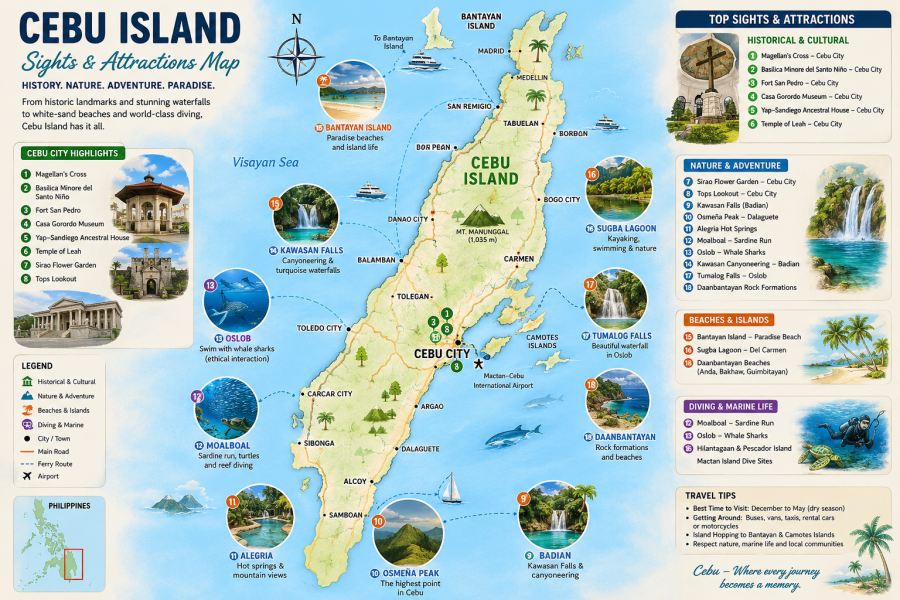
Cebu Island – Top Sights (Short Descriptions)
- Magellan's Cross – Historic cross marking the arrival of Christianity in the Philippines in 1521.
- Basilica Minore del Santo Niño – The country's oldest Roman Catholic church, home to the revered Santo Niño statue.
- Fort San Pedro – A well-preserved Spanish colonial fort with gardens and a small museum.
- Temple of Leah – A grand Roman-inspired monument offering panoramic views over Cebu City.
- Sirao Garden – Colorful flower gardens often called the "Little Amsterdam of Cebu."
- TOPS Cebu – Popular viewpoint with spectacular sunset and city skyline views.
- Kawasan Falls – Famous turquoise waterfalls known for swimming and canyoneering.
- Osmeña Peak – The highest point on Cebu Island, offering breathtaking mountain scenery.
- Moalboal – Renowned for the Sardine Run, sea turtles, snorkeling, and diving.
- Pescador Island – World-class dive site with dramatic walls, corals, and abundant marine life.
- Oslob – Best known for whale shark encounters and nearby waterfalls.
- Tumalog Falls – A picturesque curtain-like waterfall surrounded by lush forest.
- Sumilon Island – Small island featuring a beautiful shifting sandbar and crystal-clear waters.
- Bantayan Island – Relaxed island paradise with white-sand beaches, island hopping, and stunning sunsets.
- Virgin Island – A pristine tropical island ideal for snorkeling and day trips.
- Malapascua Island – Internationally famous for thresher shark diving, white beaches, and a laid-back island atmosphere.
- Simala Shrine - The Monastery of the Holy Eucharist, also known as the Our Lady of Lindogon Shrine and commonly known as the Simala Shrine or the Simala Parish Church is a Roman Catholic pilgrimage church dedicated to the Virgin Mary in Sibonga, Cebu, Philippines.
Source Text: https://en.wikipedia.org/wiki/Cebu_(island) and ChatGPT
 Druckversion
Sitemap
Druckversion
Sitemap
Urheberrechtshinweis 2022-2026 (©), Helmut Rufer, alle Bilder dieser Seite unterliegen urheberrechtlichem Schutz - Copyright notice 2022-2026 (©), Helmut Rufer, all images on this site are protected by copyright. Hintergrund Bild/Background Pic: Paolo Forlani, Public domain, via Wikimedia Commons