
Mt. Pinatubo, Clark , Angeles City
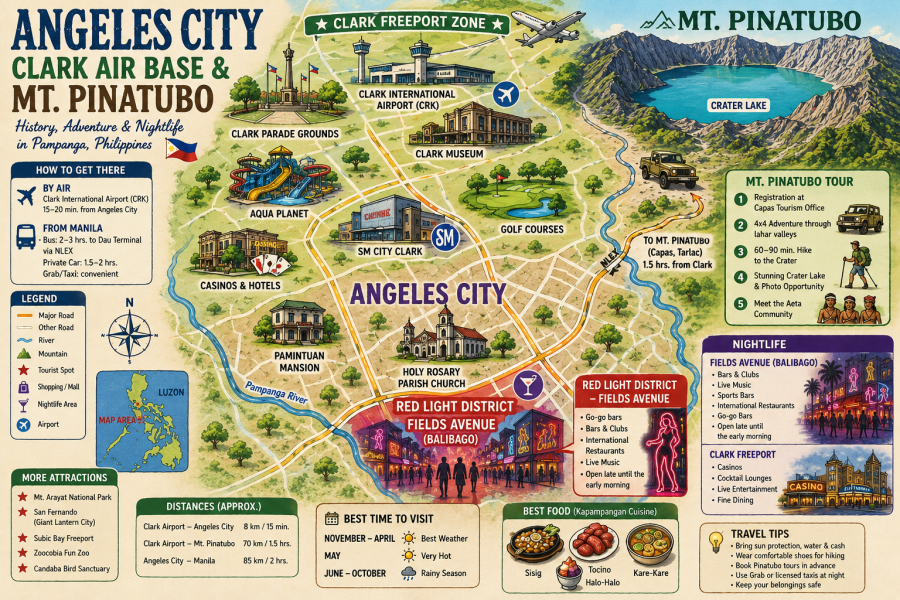
Angeles City, located about 85 km north of Manila, is one of the most popular destinations in Central Luzon. It combines history, modern entertainment, excellent food, and easy access to one of the Philippines' most spectacular natural attractions—Mt. Pinatubo. The nearby Clark Freeport Zone, built on the former U.S. Clark Air Base, is now a modern business, leisure, and aviation hub.
How to get there
By Air:
Clark International Airport (CRK) is only 15–20 minutes from Angeles City.
Direct international flights operate from several Asian destinations.
Domestic flights connect Clark with Cebu, Davao, Boracay (Caticlan), Palawan and more.
From Manila:
Bus: 2–3 hours from NAIA or Cubao/Pasay to Dau Terminal.
Private car: 1.5–2 hours via NLEX.
Grab or taxi is the easiest way to travel between Clark and Angeles.

Mt. Pinatubo
Distance: about 1.5 hours from Clark.
A typical tour includes:
- Registration at Capas Tourism Office
- 4×4 adventure through volcanic lahar valleys
- 60–90minute hike
- Stunning turquoise crater lake
- Opportunity to meet local Aeta communities
Tour duration
- 6–8 hours
- Difficulty
- Easy to moderate
- Suitable for most travelers with reasonable fitness
Best season
- November–April (dry season)
- Heavy rain may lead to trail closures during the wet season.
Mt. Pinatubo Eruption (1991)
The eruption of Mount Pinatubo on 15 June 1991 was one of the largest volcanic eruptions of the 20th century. Located on the island of Luzon, about 90 km northwest of Manila, the volcano had been dormant for over 500 years before erupting.
Timeline
- April 1991: Small earthquakes and steam explosions signaled renewed volcanic activity.
- May–June 1991: Scientists from the Philippine Institute of Volcanology and Seismology (PHIVOLCS) and the U.S. Geological Survey (USGS) monitored increasing activity and recommended evacuations.
- 15 June 1991: The volcano produced its climactic eruption, coinciding with the passage of Typhoon Yunya, which mixed heavy rain with volcanic ash.
- Magnitude
- Volcanic Explosivity Index (VEI): 6
- Ash plume reached over 35 km (22 miles) into the atmosphere.
- Approximately 10 cubic kilometers of volcanic material were ejected.
- Around 17 million tons of sulfur dioxide (SO₂) entered the stratosphere.
Impact
Human Impact
- More than 800 people lost their lives, many due to collapsing roofs under the weight of wet volcanic ash.
- Over 1 million people were affected.
- Tens of thousands of Aeta, the Indigenous people living near the volcano, were displaced.
Clark Air Base
- One of the hardest-hit locations was Clark Air Base, then a major U.S. military installation.
- Thick ash covered aircraft, buildings, and runways.
- Many structures collapsed under the heavy ash.
- The U.S. military evacuated personnel.
- The base was eventually closed and later redeveloped as today's Clark Freeport Zone and Clark International Airport.
Lahar
Even after the eruption, seasonal rains mixed with volcanic ash to create lahars (fast-moving volcanic mudflows), which:
- Buried villages
- Destroyed roads and bridges
- Continued causing damage for several years
Global Effects - The eruption had worldwide consequences.
- Global average temperatures dropped by about 0.4–0.6°C over the following two years.
- Sunsets became unusually colorful around the world due to volcanic aerosols in the atmosphere.
- It remains one of the best-studied examples of how major volcanic eruptions can temporarily cool Earth's climate.
Today
- Mount Pinatubo has transformed into one of the Philippines' most spectacular natural attractions.
- The summit now features a beautiful turquoise crater lake.
- Visitors reach the crater via a 4×4 lahar trail followed by a 60–90 minute hike.
- The surrounding landscape still displays dramatic volcanic canyons and ash fields, offering a striking reminder of the 1991 eruption.
- The eruption of Mount Pinatubo is widely regarded as a success story in volcanic disaster preparedness: timely scientific monitoring and large-scale evacuations are believed to have saved many thousands of lives.
Clark Freeport Zone
Formerly Clark Air Base, today it offers:
- Clark Museum
- Clark Parade Grounds
- Duty-free shopping
- Golf courses
- Luxury hotels
- Casinos
- Wide cycling and jogging areas
The atmosphere is clean, green and much quieter than downtown Angeles.
Clark Museum
- American military history
- Clark Air Base
- Mt. Pinatubo eruption
- Development of Clark Freeport
Holy Rosary Parish Church
- Beautiful Spanish-era church located in historic Angeles.
Pamintuan Mansion
- Museum covering the history of Pampanga and the Philippine Revolution.
SM City Clark
- One of Central Luzon's largest shopping malls with restaurants, cinemas and nightlife nearby.
Aqua Planet
- One of the Philippines' biggest water parks.
Angeles has one of the Philippines' most famous nightlife districts.
Fields Avenue (Walking Street)
Known for:
- Bars
- Live music
- Sports bars
- International restaurants
- Go-go bars
- Late-night cafés
This area is lively until the early morning hours. Use normal city precautions, keep valuables secure, and prefer Grab or licensed taxis at night.
Clark Freeport
A more upscale evening atmosphere with:
- Casinos
- Cocktail lounges
- Hotel bars
- Live entertainment
- Fine dining
Ideal for couples and families looking for a quieter night out.
Source Text, based on ChatGPT
Source Pic, own work, based on Chat GPT
 Druckversion
Sitemap
Druckversion
Sitemap
Urheberrechtshinweis 2022-2026 (©), Helmut Rufer, alle Bilder dieser Seite unterliegen urheberrechtlichem Schutz - Copyright notice 2022-2026 (©), Helmut Rufer, all images on this site are protected by copyright. Hintergrund Bild/Background Pic: Paolo Forlani, Public domain, via Wikimedia Commons