
Munich
After completing my studies, my first job took me to Frankfurt am Main, though I had always known that I wanted to move to Munich in the long run. I was simply captivated by the Southern German, Bavarian way of life and by what I consider the most beautiful city in Germany. In the late 1990s, I had the opportunity to transfer to Munich for work, and I have no intention of ever leaving. On this page, I have put together some information about the Bavarian state capital.
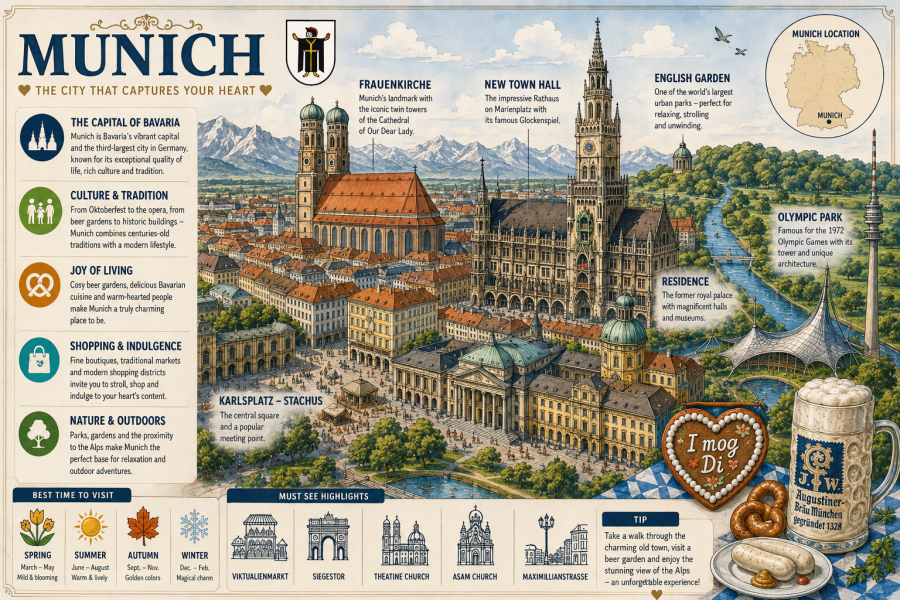
Munich is the capital of Bavaria, is situated on the Isar River, and is Germany's third-largest city after Berlin and Hamburg. The city combines Bavarian tradition with international business, art, culture, and a vibrant nightlife.
| Key Figure | Munich |
| Population | (May 31, 2026) 1,605,890 |
| Area | 310.73 km² |
| Population density | 5,189 inhabitants/km² |
| City districts | 25 |
| Elevation | approx. 519 m above sea level |
| City boundary | 118.7 km |
| First mentioned | 1158 |
| Overnight stays 2025 | 19.68 million |
| Guest arrivals 2025 | 9.31 million |
| Tallest structure | Olympic Tower – 291 m |
Brief Overview: History of Munich
- 1158: Munich is first mentioned in historical records. The name derives from the phrase "by the monks."
- 1255: Munich becomes the seat of the Wittelsbach dynasty and develops into the political center of Bavaria.
- 1506: Munich becomes the sole capital of the united Duchy of Bavaria.
- 1806: Bavaria becomes a kingdom; Munich becomes a royal capital city.
- 19th Century: Significant development into a major city for art, culture, science, and architecture.
- 1918: End of the Bavarian monarchy and proclamation of the Free State of Bavaria.
- 1933–1945: Munich becomes a key center for the NSDAP (Nazi Party). The city is deeply marked by Nazi rule and the Second World War.
- 1945: Munich suffers heavy destruction during the war.
- Post-1945: Reconstruction and development into a modern economic and cultural metropolis.
- 1972: The Summer Olympics leave a lasting mark on Munich; the Olympic Park and Olympic Stadium are built.
Today: Munich is an international metropolis and Bavaria’s political, economic, scientific, and cultural center.
In short: From a medieval settlement, Munich evolved—via its status as the Wittelsbach seat and royal capital—into a modern major European city, shaped by Bavarian tradition, culture, and economy, as
well as international significance.
Key Highlights
- Marienplatz & New Town Hall – the city's historic center
- Frauenkirche – Munich’s most famous landmark
- Viktualienmarkt – culinary hub of the Old Town
- Munich Residenz – former royal palace
- Nymphenburg Palace – magnificent Baroque palace complex
- English Garden – one of the world’s largest inner-city parks
- Eisbach Wave – world-famous surf spot in the heart of Munich
- Deutsches Museum – one of the world’s most important science museums
- Kunstareal – the Pinakotheken and numerous other museums
- Olympic Park & Olympic Stadium – commemorating the 1972 Olympic Games
- BMW Welt & BMW Museum
- Allianz Arena – icon of Munich’s football scene
- Maximilianstraße – luxury, architecture, and shopping
- Hofbräuhaus – world-famous Munich beer hall
- Königsplatz – Neoclassical architectural ensemble
Culinary Munich
Culinary-wise, Munich is defined above all by a blend of Bavarian tavern culture, beer gardens, breweries, and modern gastronomy. At the same time, the city boasts a vibrant international and upscale dining scene.
Typical Munich
- Pretzels
- Weisswurst (white sausage) with sweet mustard
- Schweinshaxe (roasted pork knuckle)
- Roast pork with dumplings
- Obatzda (spiced cheese spread)
- Leberkäse (meatloaf) / Leberkäse roll
- Steckerlfisch (grilled fish on a stick)
- Potato and bread dumplings
- Apple strudel
- Auszogne (fried yeast pastry)
- Munich Helles & Weissbier (wheat beer)
- The Viktualienmarkt has existed since 1807 and today comprises around 100 stalls.
Beer Culture: Munich is closely linked to its traditional breweries and beer gardens. Munich’s beer garden culture, large brewery taverns, and Oktoberfest are particularly defining features.
Key Nightlife Districts
In the past, one would have said Schwabing; unfortunately, the Schwabing of today bears little resemblance to the Schwabing of the 1980s and 90s. Nowadays, nightlife is concentrated in other parts of the city.
- Glockenbachviertel
Bars, cafés, clubs, and a very lively, urban atmosphere.
- Gärtnerplatzviertel
Restaurants, cocktail bars, and nightlife centered around Gärtnerplatz.
- Maxvorstadt
Student-oriented and cultural nightlife featuring bars and smaller clubs.
- Werksviertel-Mitte
A modern Munich nightlife district centered around the Ostbahnhof (East Station)—clubs, bars, events, and concerts.
- Haidhausen
A somewhat quieter and more stylish area: bars, restaurants, and pubs.
- Kultfabrik / former industrial site
Historically significant for Munich’s club scene; parts of the area have since been redeveloped.
Munich: A City of Sport
Munich is one of Germany's most important cities for sport. Numerous clubs across a wide range of disciplines compete in the top German leagues.
Naturally, all of this is overshadowed by the football club FC Bayern Munich.
Reference, https://www.muenchen.de/en/home, graphic based on ChatGPT
 Druckversion
Sitemap
Druckversion
Sitemap
Urheberrechtshinweis 2022-2026 (©), Helmut Rufer, alle Bilder dieser Seite unterliegen urheberrechtlichem Schutz - Copyright notice 2022-2026 (©), Helmut Rufer, all images on this site are protected by copyright. Hintergrund Bild/Background Pic: Paolo Forlani, Public domain, via Wikimedia Commons