
Cephalopods (Class Cephalopoda)
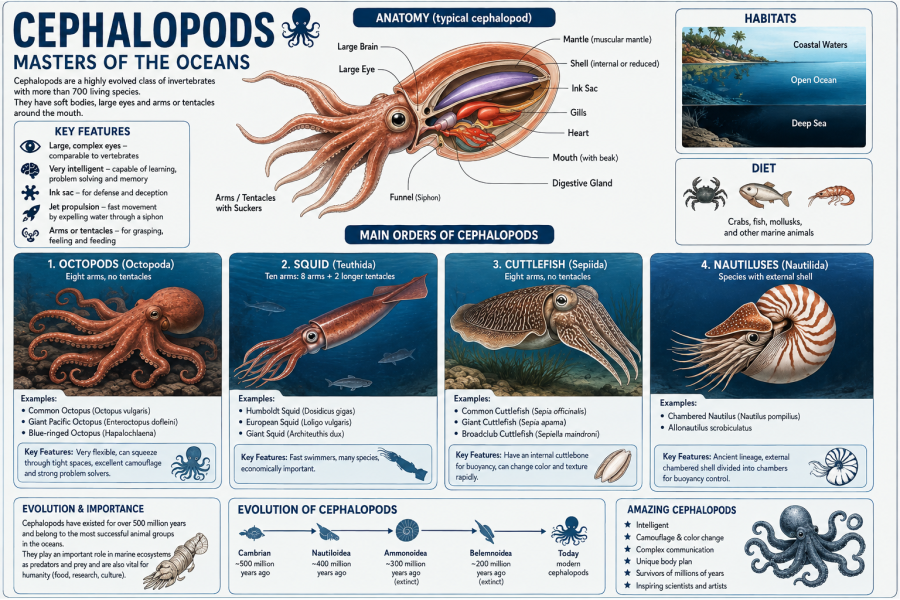
Image source, own work, graphic based on ChatGPT
Cephalopods (Class Cephalopoda)
General Information
Cephalopods (Class Cephalopoda) are a class of mollusks (Phylum Mollusca) and are considered the most intelligent invertebrates on Earth. The name Cephalopoda means "head-foot", referring to the arms and tentacles attached directly to the head.
- Phylum: Mollusca (Mollusks)
- Class: Cephalopoda
- Living species: Approximately 800 species
- Habitat: All oceans, from shallow tropical reefs to the deep sea
- Size: From just a few centimeters to more than 15 meters (50 ft) in total length
Major Groups of Cephalopods
Octopuses (Order Octopoda)
Characteristics
- Eight muscular arms with suckers
- No external shell
- Highly intelligent and capable of problem-solving
- Mostly live on the seafloor
- Masters of camouflage through rapid color and texture changes
Well-Known Species
- Common Octopus (Octopus vulgaris)
- Giant Pacific Octopus (Enteroctopus dofleini)
- Mimic Octopus (Thaumoctopus mimicus)
- Blue-Ringed Octopus (Hapalochlaena spp.)
Squids (Order Teuthida)
Characteristics
- Eight arms and two long feeding tentacles
- Streamlined body for fast swimming
- Excellent jet propulsion
- Mostly inhabit the open ocean
Well-Known Species
- Humboldt Squid
- European Squid
- Giant Squid (Architeuthis dux)
- Colossal Squid (Mesonychoteuthis hamiltoni)
Cuttlefish (Order Sepiida)
Characteristics
- Possess an internal calcareous cuttlebone
- Exceptional camouflage abilities
- Hover gracefully using undulating side fins
- Common in shallow coastal waters
Well-Known Species
- Common Cuttlefish (Sepia officinalis)
- Giant Australian Cuttlefish (Sepia apama)
Nautiluses (Order Nautilida)
Characteristics
- Only living cephalopods with an external shell
- Have 60–90 tentacles without suckers
- Often referred to as "living fossils"
- Mainly found in the Indo-Pacific region
Well-Known Species
- Chambered Nautilus (Nautilus pompilius)
Diet
Cephalopods are carnivorous predators.
They feed on:
- Fish
- Crabs
- Shrimp
- Mollusks
- Worms
- Smaller cephalopods
They capture prey with their arms or tentacles and tear it apart using their powerful beak.
Reproduction
- Separate males and females
- Males transfer sperm packets using a specialized arm called the hectocotylus
- Females lay eggs
- Many species reproduce only once before dying (semelparity)
- Distribution
Cephalopods inhabit:
- Coral reefs
- Coastal waters
- Open oceans
- Deep-sea environments
- Polar seas
- Tropical waters
They are found exclusively in marine environments worldwide.
Fascinating Facts
- Cephalopods have three hearts.
- Their blood is blue because it contains the copper-based protein hemocyanin.
- They possess the largest and most complex brains of all invertebrates.
- An octopus can squeeze through any opening large enough for its beak.
- Many squid and deep-sea species produce bioluminescence.
- Nautiluses are the only living cephalopods that retain a fully developed external shell.
Cephalopods are among the most extraordinary animals in the ocean. Their combination of advanced intelligence, remarkable camouflage, rapid locomotion, and highly specialized adaptations has made them one of the most successful groups of marine predators for over 500 million years.
Source Text, reference, https://en.wikipedia.org/wiki/Cephalopod
 Druckversion
Sitemap
Druckversion
Sitemap
Urheberrechtshinweis 2022-2026 (©), Helmut Rufer, alle Bilder dieser Seite unterliegen urheberrechtlichem Schutz - Copyright notice 2022-2026 (©), Helmut Rufer, all images on this site are protected by copyright. Hintergrund Bild/Background Pic: Paolo Forlani, Public domain, via Wikimedia Commons